Raman in a marriage reception

C.V. Raman was obsessed with science, and he was actively thinking about research problems even on odd occasions when he was supposed to be socializing. Nagendra Nath, in 1971, recounts1:

In November 1969, he and Lady Lokasundari Raman were graciously pleased to attend the marriage reception of my daughter. Professor drew me aside outside the reception hall and told me for nearly half-an-hour that his latest problem was to give a proper theory of earthquakes. The present theories were based on models which were highly deficient as they did not properly take into account the shape of the earth and the wave nature of the disturbance.

Nearly half an hour !!
Imagine the condition of Nagendra Nath :-)

  1. Nath, N. S. Nagendra. ‘My Professor’. Current Science 40, no. 9 (1971): 234–35. https://www.jstor.org/stable/24074207.
    ↩︎
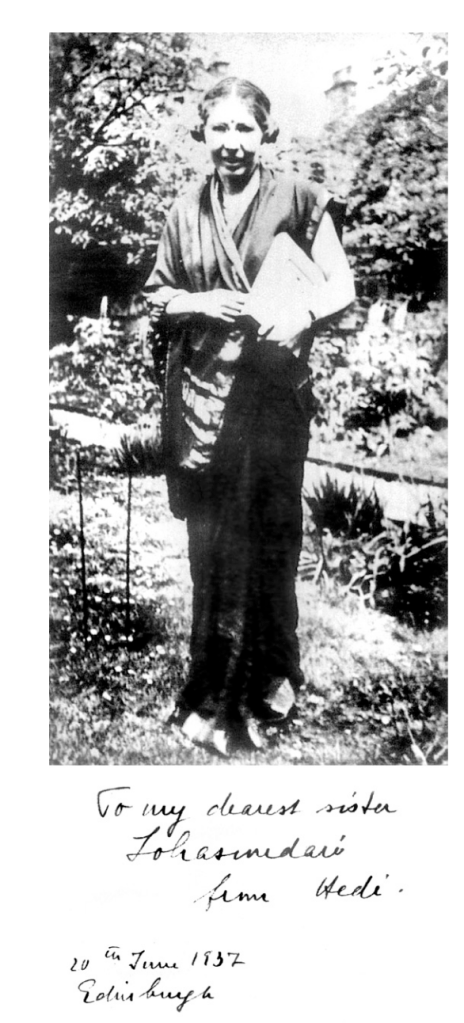
Hedi Born’s picture

This is Hedi Born (wife of Max Born) sending a picture with a note to Lokasundari Ammal (CV Raman’s wife) in 1937.

Max Born and his family spent some time at IISc, Bangalore, in 1935-36.

Amazing to see how communication channels have changed, but the human urge to communicate remains the same..

picture source: (Venkataraman, G.; Journey into Light: Life and Science of C.V. Raman. Indian Academy of Sciences, 1989. p. 364)

Conversation with Chaitanya Athale

Chaitanya is a professor of biology at IISER Pune and works on quantifying biology at the cellular scale. His lab focuses on cytoskeleton and cell shape research and explores synthetic biological roots to address a variety of questions at the cellular scale.

In this freewheeling conversation, we talked about quantitative biology in his lab, reading, the German language, his recent comic-themed book, and a bit on philosophy of biology as we explored his intellectual journey. Also, don’t miss the 3D model he shows to explain his research.

References with links:

‘Chaitanya Athale – IISER Pune’. Accessed 3 January 2026. https://www.iiserpune.ac.in/research/department/biology/people/faculty/regular-faculty/chaitanya-athale/6.

‘Dr. Chaitanya Athale – Lab – Cytoskeleton and Cell Shape Research – Synthetic Biology’. Accessed 3 January 2026. https://sites.iiserpune.ac.in/~cathale/.

‘‪Chaitanya Athale – ‪Google Scholar’. Accessed 3 January 2026. https://scholar.google.com/citations?user=Volq2gEAAAAJ&hl=en.

Chaitanya Athale | LinkedIn’. Accessed 3 January 2026. https://www.linkedin.com/in/chaitanyaa/?originalSubdomain=in.

Arias, Alfonso Martinez. The Master Builder: How the New Science of the Cell Is Rewriting the Story of Life. Basic Books, 2023.

 ‘Athale Lab: CyCelS 💉💉💉💉🚲🤿⛵ (@AthaleLab) / X’. 9 January 2025. https://x.com/athalelab.

On Criticism

How to criticize somebody’s work? This is a question we often ask in academia, especially while writing referee reports for articles in journals and theses submitted by students. It is important to learn constructive criticism of academic work, which makes criticism a tool that can lead to positive feedback. When we talk about positive feedback, it does not mean that you will have to applaud the work. It means that anybody who is receiving the feedback should be able to build on it and improve their work.

In this regard, the philosopher Daniel Dennett has come up with some thoughts on critical commentary of somebody’s work. One of the key points he notes: ‘You should attempt to re-express your target’s position so clearly, vividly, and fairly that your target says, “Thanks, I wish I’d thought of putting it that way”’.

This way of changing the perspective on a piece of work is one of the crucial aspects of constructive criticism. It helps you to understand the role as a reviewer in not only correcting somebody’s mistake but also helping them to build on their own thoughts. Many times, criticism is looked down on as a negative thing. But done this way, it is probably one of the most enriching processes, not only for the person who is receiving the feedback, but also for the person who is criticizing the work. The correct way to criticize is to think with different perspectives and add to the body of knowledge that the author has already presented. In that way, knowledge is progressed and corrected for mistakes, if any.

How to Build Atomic LEGOs?

In ~8min, I try to explain how and why to build atomic Legos and their potential applications.

The video is for non-experts.

Reference for further reading:

Geim, A. K., and I. V. Grigorieva. ‘Van Der Waals Heterostructures’. Nature 499, no. 7459 (2013): 419–25. https://doi.org/10.1038/nature12385.

Teaching & Meaning

What adds meaning to my academic work?

Perhaps, an anonymous feedback on your teaching is one of them….

very well taught course at a well defined pace. The interesting way various different aspects and fields in Optics was introduced was fascinating, made us so very keen on knowing more! The mind maps at the beginning of every topic, the indexes professor made was a great way to keep the bigger picture in mind and helped us glide through it. The assignment was also a great way to make us go through materials without feeling it it be imposing, rather finding it more interesting! Thank you so much Sir for this amazing course, the enthusiastic way in which you taught, all the great conversations you engaged in with us, and opened our eyes to explore so much more in this field! thank you!!

I had a diverse class (BS-Physics majors, MS Quantum Tech, iPhD) with 110+ students, and I am glad a lot of students enjoyed the course this time.
I am a bit overwhelmed by the positive feedback I received on my teaching methods. For sure, I learnt about the subject as much as they did.

And as I always say: there is more to learn…for all of us..

Human interaction zindabad :-)

Create to Understand

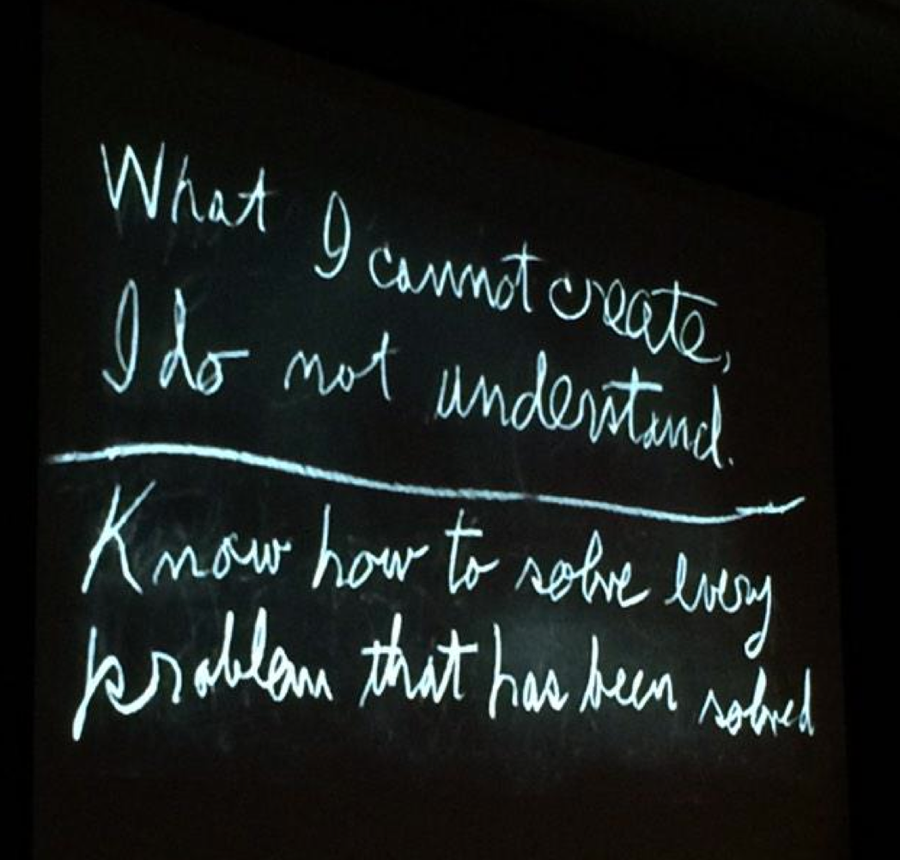
Below are two quotes on the blackboard of Feynman’s office in Caltech which were found just after his death.

 
The first of these quotes by Feynman is a guiding principle for anyone who wants to learn. The second quote is an idealistic one, but a good approach to becoming a ‘problem-solving’ researcher. Feynman was a master of this approach.
 
From a philosophy of science perspective, researchers can be both ‘problem creators’ and ‘problem solvers’. The latter ones are usually famous.
 
Michael Nielsen, a pioneer of quantum computing and champion of open science movement, has an essay titled: Principles of Effective Research, in which he explicitly identifies these two categories of researchers, and mentions that “they’re not really disjoint or exclusive styles of working, but rather idealizations which are useful ways of thinking about how people go about creative work.”.
 
He defines problem solvers as those “who works intensively on well-posed technical problems, often problems known (and sometimes well-known) to the entire research community in which they work.” Interesting, he connects this to sociology of researchers, and mentions that they “often attach great social cache to the level of difficulty of the problem they solve.”
 
On the other hand, problem creators, as Nielsen indicates, “ask an interesting new question, or pose an old problem in a new way, or demonstrate a simple but fruitful connection that no-one previously realized existed.”
 
He acknowledges that such bifurcation of researchers is an idealization, but a good model to “clarify our thinking about the creative process.”
 
Central to both of these processes is the problem itself, and what is a good research problem depends both on the taste of an individual and the consensus of a research community. This is one of the main reasons why researchers emphasize defining a problem so much. A counterintuitive aspect of the definition of the problem is that one does not know how good the ‘question’ is until one tries to answer and communicate it to others. This means feedback plays an important role in pursuing the problem further, and this aptly circles back to Feynman’s quote: “What I cannot create, I do not understand”.


Physics Ideas for Entrepreneurs

Starting a new (ad)venture

A YouTube channel dedicated to discussing physics ideas for entrepreneurs

I bring ideas from an ocean of physics and present them to anyone interested in using them for business and entrepreneurship. These are not physics lectures, but discussions on ideas with a perspective of economic utility.

As with all my ventures, it is open source.

Join me in this journey, and please share and subscribe

The first video is out: